An African proverb, taken literally

If you think you are too small to make a difference,
try spending a night with a mosquito.

AI is the lever. One idea, held long enough, is the place to stand.

Archimedes promised the rest.

The onemosquito mark — a mosquito carrying the world on its wings

onemosquito.ai is thirty years of research under one name — begun in Vienna with the smallest of means and one conviction that has outlived every hardware cycle: scale is not a precondition for impact. It never was.

It started in the early 1990s with Interventional Video Tomography — teaching a camera to see the patient in three dimensions, so the surgeon could navigate what the eye could not. The idea has not changed in thirty years; only its lever has. Image-guided surgery became the Virtual Patient; the Virtual Patient becomes a sovereign clinical decision support system, whose first module — AIDOCVISION REMOTE — learns to read the oral cavity the way a surgeon does. Two lines of work carry it, with equal weight: one across Vienna, Lagos and Athens, one between Vienna and Walailak University in Thailand.

By 1997 the idea had hardware. An optical interface folded X-ray, CT and MR images into the surgeon's field of view through a head-mounted display — x-ray vision for the operating room, developed at the Vienna University Clinic of Maxillofacial Surgery and funded by the Austrian Science Fund as research project P 12464 (project description). The same line reached patients commercially: the Virtual Patient® system of ARTMA Biomedical — the company's website of that era is preserved in the Internet Archive — was CE-certified as a class IIa medical device for intraoperative image-guided navigation, controlling all rigid bodies in metric 3D: tooth roots against a bone boundary, not pixels on a screen. Twice a world first: the first augmented-reality visualisation in a head-mounted display in the operating room, and the first telenavigation surgery — a real-time surgical teleconsultation over stereotactic data, performed in August 1996 across 500 kilometres (Remote stereotactic visualization, 1997). The specialty took note: in 1998 the American College of Oral and Maxillofacial Surgeons honoured Rolf Ewers with the W. Harry Archer Award in Cleveland, Ohio. Augmented reality in surgery, years before the phrase had a market — and a reminder of what this group does with “impossible”: it ships it, certifies it, and waits for the world to catch up.

Oral cancer hides in plain sight. It sits on a surface a clinician can see and touch, yet more than six in ten cases are found only at stage III or IV, when five-year survival has already fallen below half — roughly 390,000 new cases and 188,000 deaths worldwide in 2022. The tumour is visible. What is missing is not the eye but the moment.

EK Nr: 1381/2026 AIDOCVISION REMOTE Multimodal AI-assisted early detection of oral malignancies with stereotactic intraoral scanner documentation in private practice — a prospective, observer-blinded diagnostic pilot study. The scanner named in the title describes the Vienna acquisition standard, not a condition of participation: the primary modality at every site is photographic, and the scanner is a parallel channel where a device is already there for its own clinical purpose.

AIDOCVISION REMOTE is a prospective, observer-blinded diagnostic pilot study built around that gap. It asks how well an AI-generated risk classification of an oral lesion agrees with the physician's own — and answers it where patients are actually seen, including a single private practice. That is the wager: a restrained instrument, placed at the edge of the system, aimed at a global problem. All inference runs locally, air-gapped, on an open-source stack — auditable before admired. And the approach inverts the old one. In 1997 the system brought images to the surgeon's eye; now it brings a second reading to the chair. It does not deploy a universal oracle — the cathedrals have those on offer already. The instrument is calibrated chairside, to the individual physician who holds it, not to an average that exists nowhere. Its geometry descends from Interventional Video Tomography, described for surgery thirty years ago (Truppe et al., SPIE 1995); that the same geometry now searches for cancer is a turn that will read as obvious only in retrospect. A mosquito is small enough to ignore and consequential enough to change a continent. So is a single private practice, given the right lever.

The record is public: Google Scholar  ·  ResearchGate  ·  ORCID 0000‑0002‑1816‑2329

Big institutions hold press conferences. Evolution does not. Its decisive turns are never announced, only recognized in retrospect — a small mutation in an overlooked lineage that, generations later, turns out to have changed everything. A small research group moves the same way: light, precise, impossible to ignore. Every project under this umbrella follows that logic — find the one point where a small, exact intervention flips the whole system, and place the bite there. Recognition can come later.

The coral dot in our mark is not decoration. It is the point of contact — where thirty years of surgical experience touch the world through artificial intelligence.
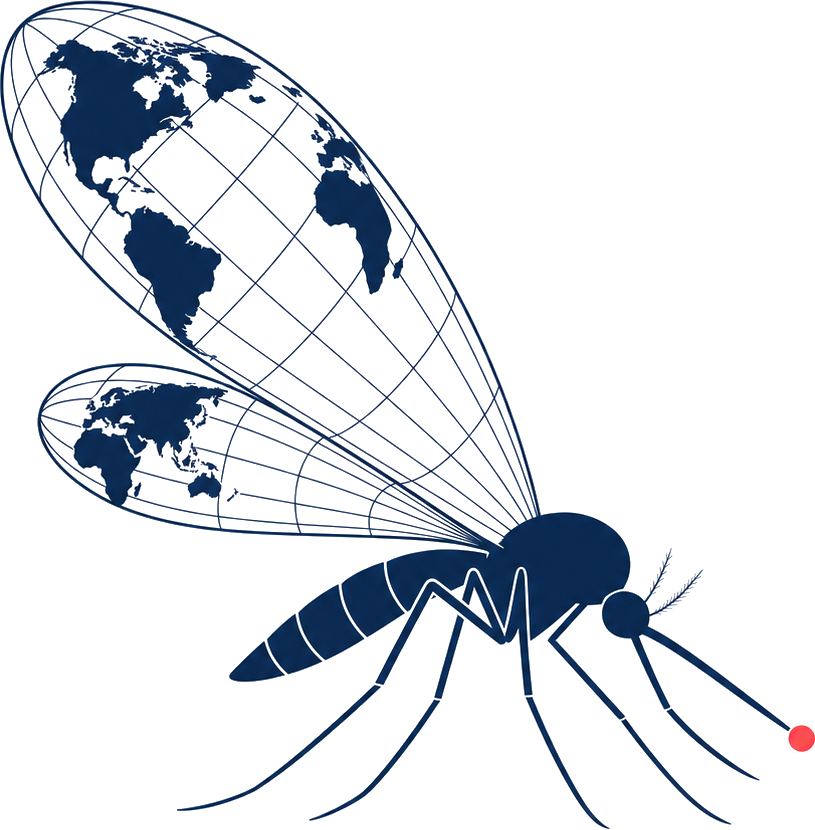
Small bite. Global reach.

02

The vision: Sovereign AI

A clinical decision support system that belongs to the clinicians who use it. Sovereign AI means open weights and open source, inference on the institution's own hardware, federated training in which primary patient data never leave the centre that recorded them, and modules — oncology, implantology, plastic surgery — that a department can inspect, retrain and switch off. Not a service consumed through someone else's interface: an instrument the clinic owns. Ownership is not a feature of the vision — it is the vision.

Why now — PHONE meets Sovereign AI

State-of-the-art healthcare, democratized

In 1996 the first telenavigation surgery needed dedicated hardware and a fixed line to carry stereotactic data across 500 kilometres. Today that bandwidth sits in almost every pocket: a 5G smartphone. Combined with Sovereign AI — models that run on the clinic's own hardware and answer to no one else — it changes, for the first time in the history of medicine, who state-of-the-art care is for. A specialist-grade second reading can now reach the common man: the village practice, the district clinic, the patient who would never have been referred in time. This is our vision — not better medicine for the few who can travel to it, but the best available reading brought to wherever a patient already is.

And the curve only steepens: phones now ship with neural processors that run inference on the device itself, camera systems engineered for computational close-up photography, and the first 3D sensing — with 6G on the horizon for the 2030s. The infrastructure of democratized medicine is being built into the common man's pocket, whether medicine notices or not.

Clinical decision support

Risk classification at the chair, at the moment of decision. Every module is validated in an observer-blinded study before it is allowed near a patient, and it enters the clinic as an instrument the physician commands — never as an authority the physician obeys.

Teleconsultation

Specialist second opinions that travel farther than any patient has to — a second reading brought to the chair rather than a referral sent away. The team stays small; its judgment does not.

Global collaboration

Research partnerships across Europe, Africa and Asia, held between equals — because the diseases we work on wear a different face on each continent, and a model proven in only one of them proves nothing.

The asymmetry — why small wins here

Defensible by design

The timing is not an accident. Clinical AI is consolidating into services owned by platforms at exactly the moment European regulation — the MDR, the GDPR, the EU AI Act — makes on-premises, auditable AI the path of least resistance for a hospital. Sovereign AI is not idealism; it is the compliant default, arriving just as open-weight foundation models became good enough to build on.

And what this group holds is hard to copy: validation cohorts on three continents, covering disease profiles — a polyaetiology cohort in West Africa, the betel-quid aetiology of Southeast Asia — that no single-continent dataset reproduces; a stereotactic documentation standard that turns routine clinical imaging into structured training data; and a team that has already carried a class IIa surgical device through CE certification once. Every module that survives its blinded validation becomes an instrument a department can adopt without surrendering a single patient record — which is precisely what makes it adoptable at all. The moat is not secrecy. It is thirty years of documentation that no funding round can buy.

First public presentation — Athens, 15 September 2026

From ChatGPT to Sovereign AI

An Open-Source, Federated Clinical Decision Support System with Foundation-Model Modules for Oncology, Implantology and Plastic Surgery — session “AI and CMF Surgery” at the 28th Congress of the European Association for Cranio-Maxillo-Facial Surgery, Tuesday 15 September 2026, 16:00–18:00, at the Megaron Athens International Conference Centre. The slot is listed in the congress programme grid.

The vision is argued in public there for the first time, with both study lines as its evidence: AI-assisted early detection of oral malignancies where patients are actually seen, and federated foundation-model methods under which every centre stays sovereign over its own data. From ChatGPT — a borrowed oracle behind someone else's interface — to Sovereign AI: an instrument the clinic holds in its own hands.

03

The cathedral and the bazaar

In 1997, Eric S. Raymond described two ways to build software: the cathedral — closed, centralised, run by a priesthood — and the bazaar — open, distributed, correcting itself in public. Clinical AI is having the same argument right now. The cathedrals are winning the headlines while losing money at a rate no clinic could survive.

The cathedral — monolithic inference

A business model on fire

Centralised inference has yet to prove it can pay its own electricity bill. OpenAI burned $3.7 billion in the first quarter of 2026 — more than half its revenue — and its own forecasts concede $14 billion in losses this year alone. OpenEvidence, the “ChatGPT for doctors”, is free to American clinicians because pharmaceutical advertising pays for the answers. That model is not a curiosity any more: by July 2026 it ran at roughly $300 million annualised, with investor offers near a $20 billion valuation. Read that again: the ad sits inside the consultation. Every question travels to someone else's server, and the economics answer to advertisers and investors — not to the clinic.

The European wall

Regulation wrote the ending in advance

In Europe this model does not meet a market; it meets a wall. Clinical decision support is high-risk under the EU AI Act, stacked on top of the MDR — conformity assessment, post-market surveillance, auditable evidence, all of it. A cloud oracle financed by pharmaceutical advertising is not a European product with a compliance problem; it is an American business model that European regulation was written to prevent. The wall has dates: the Digital Omnibus moved the high-risk obligations to 2 December 2027 for standalone systems and to 2 August 2028 for AI inside MDR-regulated devices, and until then MDR certification remains the only route to market. Europe postponed the deadline, not the decision. It will not gain traction here — not because Europe is slow, but because Europe already decided.

The bazaar — proven chairside

The inference goes to the patient

We did not argue the counterpoint; we published it. In a peer-reviewed feasibility study (Oral Oncology Reports, 2025), local inference on a locally hosted LLM matched or exceeded the online models in a first feasibility test — chairside, on clinic hardware, with no patient data leaving the room. That is the bazaar: open-weight models, distributed development, sovereignty by architecture rather than by promise. The inference is already chairside, and the smartphone is no longer a forecast: benchmarked on iPhone and iPad against open-ended clinical case vignettes, compact models already carry clinical reasoning locally — with memory, not processing power, as the binding constraint. The counterpoint in one sentence: they carry the physician's question to the data centre — we carry the inference to where the data lives, the patient.

The concession first: on medical benchmarks the frontier proprietary models still lead, across sixty-one models in seventy-one configurations. What that lead measures is the open question. Benchmark scores correlate only moderately with clinical performance — a Spearman rank correlation of 0.59 — and they miss patient communication, longitudinal care and clinical information extraction entirely. The cathedral leads on the axis that predicts clinical value least well.

Cathedrals are monuments to their builders. Bazaars are useful to the people in them. A patient in Lagos, Athens or Vienna does not need her data to cross a border to be served by state-of-the-art medicine.

04

The projects

The projects are the vision made operational — modules of one system under construction, not ventures beside it. Each takes the same geometry, built for the operating room in the 1990s, and points it at a clinical question through AI. Two lines run in parallel: one across Vienna, Lagos and Athens, one between Vienna and Walailak. They share a protocol and a geometry, and they carry equal weight — neither is a pilot for the other.

In preparation — Vienna · Lagos · Athens

AIDOCVISION REMOTE × LAGOS

EK Nr. 1381/2026. A prospective, observer-blinded diagnostic pilot study on AI-assisted early detection of oral malignancies, run where patients are seen first — not where advanced disease finally arrives. Three research groups — Vienna, Lagos, Athens — as equal partners, each holding a cohort the others cannot. The primary modality is photographic at every site; what each partner brings is set out under Reach. Early detection works decisively when it reaches the right people. A randomised trial published in April 2026 put a number on the gap: organised, risk-based invitation reached 77 percent of the target population against 3.6 percent under the opportunistic approach that is standard almost everywhere. Reaching them is the unsolved part.

Signed — Vienna · Thailand

AIDOCVISION REMOTE × WALAILAK

A bilateral academic cooperation between the Walailak University International College of Dentistry and the Department of Oral & Maxillofacial Surgery, Medical University of Vienna, on foundation-model methods for oral health — signed in July 2026. Its clinical and methodological anchor is EK Nr. 1417/2024, the AIDOC pilot study on early detection of oral malignancies at the Medical University of Vienna; AIDOCVISION REMOTE extends the same methodology into primary care. Here the stereotactic intraoral scanner carries the primary channel, because the infrastructure at the International College of Dentistry is already in place, and the site brings an aetiology no European cohort contains — set out with its numbers under Reach. Ethics groundwork comes next; the rest will be said when there is something to show.

PILOT COMPLETED — Vienna · MONASH

AIDOCVISION REMOTE × Monash AIM for Health

A methodological cooperation with the AIM for Health Lab at Monash University, led by Assoc. Prof. Zongyuan Ge, on carrying dermatology foundation models across the vermilion border into oral mucosa. Two model families anchor the line: DermLIP, the CLIP-style vision–language model pretrained on the million-scale Derm1M corpus, and PanDerm (Nature Medicine, 2025) — itself the product of a Monash–University of Queensland–Medical University of Vienna collaboration, so the ground for this cooperation was already laid inside Vienna. The zero-shot pilot delivered the result the collaboration was built on: with no oral training data, the dermatology-trained encoder returned a clinically coherent top-three differential on an oral squamous cell carcinoma case, confirming that appearance-layer priors learned on skin do transfer into the mouth. That is the empirical basis on which the downstream DermoGPT workflow inside AIDOCVISION REMOTE now sits — a morphology-first, diagnosis-last vision layer that reports lesion appearance, image quality, and referral urgency in structured blocks rather than a headline label. The planned joint programme moves next from the appearance layer alone to the appearance layer coupled with the stereotactic geometry that AIDOCVISION contributes, towards a co-developed model with field-of-use: oral oncology and broader medical imaging. It is the model line that runs alongside the two clinical lines above; neither is a substitute for the other.

Why prospective, and why observer-blinded: because the literature on AI for oral lesions asks for exactly this and does not yet have it. A systematic review comparing deep learning against human experts on photographic oral images found eight comparative studies, not one of them at low risk of bias, performance statistically indistinguishable from expert clinicians, and closes by calling for prospective clinical trials. A second review of thirty-six studies found seven percent at low risk of bias across all domains and concluded that the expected accuracy gains remain unclear. EK Nr. 1381/2026 is not one more entry in that list. It is the study those reviews keep asking for.

05

One instrument, three teams

A vision team that owns the architecture, an AI team of state-of-the-art development agents, and a clinic team that has been circling this problem since the 1990s. None of the three could build the instrument alone; together they are exactly enough.

01 — The vision team

Architecture and direction

Led by Michael Truppe, MD — creator of the Virtual Patient® system (CE-certified as a class IIa medical device) and of Interventional Video Tomography, the constant between 1997 and today. The vision team owns the architecture: distributed, open-source software development in which nothing depends on a single building, a single vendor or a single grant. The sovereignty demanded of the AI is practised in how it is built.

02 — The AI team

Built at machine speed, bounded by evidence

Declared openly, because it breaks convention: this system is assisted by AI development agents, orchestrated and reviewed by the physicians it serves. The reason is not fashion. The autonomous task horizon of frontier agents is doubling every 89 days — four minutes of human-equivalent work in 2023, twelve hours in February 2026, a full working week extrapolated to late 2027. AGI is no longer a philosophical debate; it is a delivery schedule. The medicine most people will meet in their lifetime will be practised next to it, and a clinical instrument built the old way will not survive the collision. This one is built for it — at machine speed, bounded by evidence. A team that scales like software while the burn rate does not.

03 — The clinic team

The Vienna team, reloaded

Prof. DDr. Rolf Ewers — chair of the Vienna University Clinic of Maxillofacial Surgery through its navigation era, now emeritus, recipient of the 1998 W. Harry Archer Award of the American College of Oral and Maxillofacial Surgeons. Prof. DDr. Kurt Schicho — Medical University of Vienna, who carries the stereotactic line from the 1990s work into the present protocols. Prof. DDr. Christos Perisanidis — Professor and Head of Oral and Maxillofacial Surgery at the Dental School of the National and Kapodistrian University of Athens, formerly of the Vienna clinic, the independent academic reading in AIDOCVISION REMOTE.

What reunites the clinic team is not nostalgia. The problem they worked on in the 1990s — putting the right information in front of the surgeon at the moment of the decision — was never solved, only postponed by the hardware of the time. Artificial intelligence is the instrument the idea has been waiting for, and the people who know exactly what it has to do are the ones who tried to build it first.

And where the machine curve stops is public record too, which we cite against ourselves. AI-discovered molecules clear Phase I at 80–90 percent against a historic 40–65 — then land at about 40 percent in Phase II, indistinguishable from molecules found the old way (Drug Discovery Today, 2024). Not one has been approved by any regulator, anywhere; the field's strongest result to date is a single 71-patient trial with a lung-function signal (Nature Medicine, 2025). The reading is unambiguous: AI is superb at whatever can be measured computationally, and merely average the moment a sick person enters the room. That is not an argument against building the instrument. It is the argument for registering the study — which is why AIDOCVISION REMOTE is observer-blinded and not a demonstration video.

06

Vienna ↔ Lagos ↔ Athens ↔ Walailak

This site is the repository of work carried out across three continents. The proverb in our masthead is borrowed, with gratitude, from MAI Lab, the Medical Artificial Intelligence Laboratory in Lagos, which builds health AI for Africa on its own terms.

Four partners, none of them a supplier to the others. Each holds something the work cannot be done without, and each is named on the results.

Vienna contributes the clinical origin and the thirty-year geometry — the observation, the stereotactic documentation standard, and a cohort recruited where general patients are actually seen rather than where advanced disease has already arrived.

Lagos contributes a polyaetiology cohort in which the same tumour wears a different face, and with it the external validation a European model cannot claim on its own — on its own terms, with its own investigators, and its own ethics route.

Athens contributes a second European academic centre and independent specialist assessment: the observer-blinded reading against which agreement is measured has to come from somewhere other than the group that wrote the protocol.

Walailak contributes the betel quid and areca nut aetiology. The nut is a Group 1 carcinogen in its own right, chewed by 600 million people; with smokeless tobacco it accounts for 120,200 of 389,800 oral cancers worldwide in 2022, nine in ten in lower-middle-income countries. No European cohort reproduces that face of the disease — Walailak's International College of Dentistry does, to the stereotactic standard from the outset.

Neither line extends the other, and no site is a data source for a centre elsewhere — that model has a name, and it is not collaboration. Africa and Asia carry the two disease profiles that decide whether a model built in Vienna means anything outside it; Europe carries the burden of proving it did not simply confirm itself.

Four sites, not one, is not diplomacy. Of 86 published deep-learning algorithms for radiologic diagnosis, 81 percent lost accuracy the moment they were tested outside the data they had been built on — a quarter of them substantially. A model that has only ever seen Vienna has not been shown to work; it has been shown to remember. Four cohorts, four aetiologies, is the price of telling those apart — and the difference between a paper and a patient.

07

How the groups work

A collaboration across four time zones needs two things that are easy to confuse: one place where decisions are written down, and one place where people talk. They are not the same place. Confusing them is how collaborations rot; keeping them apart is what makes the record trustworthy.

The collaboration hub

One living document — partners, responsibilities, modalities, milestones, decisions. If it is not written here, it has not been taken. Photographs (camera and smartphone) against ground truth are the primary modality at every site; intraoral scanner imagery is a parallel channel — Vienna's standard, optional elsewhere, never a condition for a site's contribution. Commenting rights for named collaborators at onemosquito.ai/hub.

The coordination channel

A WhatsApp group for scheduling, availability, logistics and notice that a document has changed — nothing more. No patient data, no clinical photographs, no scans, no datasets, not even a screenshot with the name removed. Study data move only through the secure study route under the signed Data Sharing Agreement. The rules are published as SOP EURODOC-COMM-001 at onemosquito.ai/rules.

Closed by design. Open source, not open doors. Channel membership is by hand-approved invitation; hub access is granted per named person. Substantive channel traffic enters the hub within two working days — the only version a reviewer or an ethics committee can read. Requests to hello@onemosquito.ai. Vienna–Walailak runs under a separate agreement: patient data stay on-premises, only weights and metrics move.

Cathedrals are monuments to their builders. Bazaars are useful to the people in them.

Small bite — global reach — Sovereign AI to the common man.

Say hello

Partnerships, research, funding, or a question worth losing sleep over:

hello@onemosquito.ai

This inbox is read by a person. That is the entire org chart.